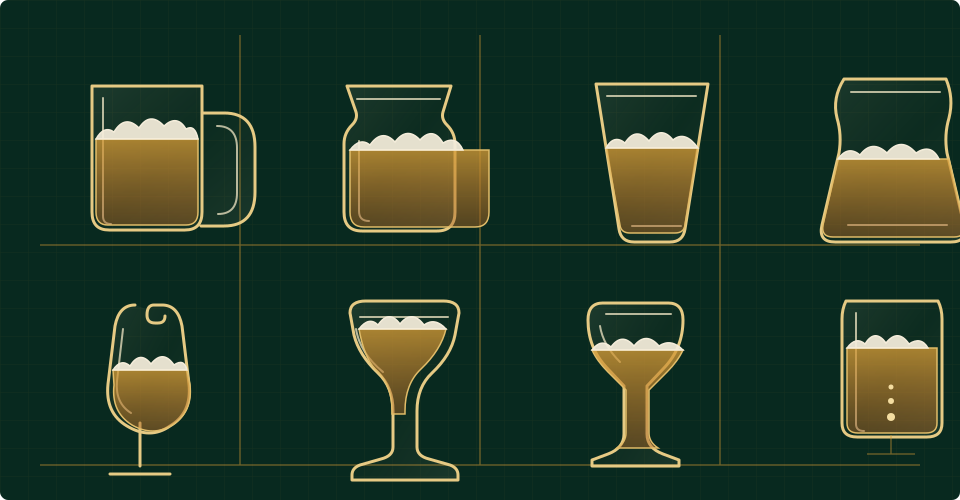
Why beer comes in different glasses
A glass does not change a beer's chemistry, but its shape affects how the drink looks, feels in the hand and presents its aroma. Capacity, height, bowl width, rim and wall thickness can influence practical headroom, ease of pouring, aroma perception, handling and heat transfer while drinking. Historical and local customs matter too. Choose glassware for the beer and setting; do not assume that every style has one uniquely correct shape. The Brewers Association cautions that we cannot claim every glass has been scientifically designed to perfectly enhance a particular beer. Brewers Association, Presenting Draught Beer: Glassware Styles, Cleaning, and Serving, slides 7–17
An experiment with 53 participants compared only two glass shapes and one Australian pale ale. Participants rated the beer in a curved-sided glass as fruitier and more intense; the study found no statistically significant difference in ratings of aroma, bitterness, sweetness or overall pleasantness. This is evidence that shape can affect perception, not proof that a particular shape physically improves every beer or that there is a universally best glass. Mirabito et al., 2017, Glass shape influences the flavour of beer, abstract and Table 2
What glass shape can change in practice
- Bowl and opening: a wider bowl leaves room to smell and swirl a beer; a narrower rim can direct aroma towards the nose. These are design considerations, not a guarantee of greater aroma intensity for every beer. Brewers Association, slides 10–13
- Height and taper: a tall glass makes colour, clarity, haze and rising bubbles easy to see. Tapered sides can support the visual presentation of the head and leave space for it. This helps explain the popularity of pilsner flutes and wheat-beer glasses; it does not alter the recipe. Brewers Association, The Brewers Association Guide to American Craft Beer, “Presenting Beer”
- Rim: an inward-curving rim can reduce sideways dispersion of aroma; an outward flare may support the head and guide beer as it is drunk. The effect depends on the actual geometry and pour. Brewers Association, slides 12–16
- Size and capacity: the glass needs room for the intended measure and its head. A smaller serving may be practical for stronger beers; in some cities, serving size is part of established local practice. Glass capacity is not automatically the same as a lawful measure. Cicerone Certification Program, Perfect Pour at Home
- Material, wall and grip: a handle and robust wall can be practical in busy service and for toasting; a stem lets the drinker hold the glass below the bowl. Do not claim that a thick wall alone keeps beer colder without considering the glass temperature, surroundings and service time. Brewers Association, slides 10–12 and 18
A guide to common glass types
| Glass | Common use and reason for choosing it | Practical limitation |
|---|---|---|
| Czech handled half-litre mug | Czech lager and everyday pub service; the handle offers a secure grip and the form belongs to local service tradition. A handle does not itself ensure the right temperature or head. Pilsner Urquell | Its robust shape is not intended to concentrate delicate aromas for tasting. |
| Dimple mug | A traditional British or American tankard. An industry presentation notes its thick glass for durability and toasting. Brewers Association | The wide opening does not concentrate aroma like a bowl with a narrower rim. |
| Willi Becher | A versatile German beer tumbler used for lagers and a range of German styles, balancing service, visibility and head presentation. | The name does not specify one capacity or a single mandated design. |
| Nonic pint | A British pub glass commonly used for bitter and other British ales; the bulge near the rim aids grip and helps protect the rim during handling. Cicerone lists it for ales, particularly British styles, and the Brewers Association describes the bulge's practical function. Cicerone Brewers Association | A durable service glass rather than an aroma-focused tasting glass. |
| Shaker pint | A straight-sided American bar glass for general service. Cicerone associates it particularly with American lagers and now other American styles. Cicerone | Its shape is not generally designed to enhance aroma; follow the intended measure and brewer's advice. |
| Imperial pint glass | Primarily a capacity description, not one distinct shape: the glass might be a Nonic or another certified design. A UK pint is 0.56826125 litres. Weights and Measures Act 1985, Schedule 1, Part IV | Distinguish capacity, measure marking and shape. Local rules apply to the measure sold. |
| Tulip / tulip pint | A broad family used for Belgian beers, aromatic ales and some stronger beers. The bowl gives room for aroma; the narrower top can help support the head. Cicerone lists the tulip for Belgian styles, and the Brewers Association guide discusses aroma and head presentation. Cicerone Brewers Association | “Tulip” covers many shapes; it is not one standardised glass. |
| Pilsner flute | Pilsner and pale lager: a tall, often tapered profile shows colour, clarity and effervescence. The Brewers Association notes that tapering can support the head. Brewers Association | A wider bowl may be preferable when assessing complex aromas. |
| Weizen / Weissbier glass | Hefeweizen and other wheat beers; its height leaves room for a generous head and presents haze and yeast sediment. Cicerone pairs it with German wheat beer and its high head. Cicerone | Tall and more vulnerable during washing and handling; allow for headroom. |
| Kölsch Stange | The narrow, straight-sided glass is traditional in Cologne for Kölsch. Brewery Früh describes it as the classic glass and part of local beer culture. Früh, Kölsch served right | A regional custom, not a rule for all top-fermented beers. |
| Altbier tumbler | A smaller straight-sided glass is typical for Düsseldorf Altbier. The city's tourism authority describes the beer as served fresh in small glasses; this is principally cultural and service context. Visit Düsseldorf, Düsseldorf Altbier | Do not mistake a regional service custom for a technical necessity of the style. |
| Maßkrug / beer stein | A large handled mug associated especially with Bavarian beer culture; the handle and robust construction suit communal service. The Brewers Association presentation includes the German stein among common forms. Brewers Association | Its large volume and open mouth are not ideal for every tasting or slow drink. |
| Goblet / chalice | A stemmed bowl for Belgian ales and other beers served in a celebratory or aroma-focused way; the wide opening allows a direct sip. The Brewers Association guide includes an abbey goblet among common forms. Brewers Association | The names cover many different shapes. |
| Snifter | A smaller, rounded glass for strong, expressive beers meant to be sipped slowly; a modest serving and bowl encourage deliberate nosing. Brewers Association suggests snifters for intense sipping beers. Brewers Association | Beer in a small bowl can warm more quickly in the hand; it is not a universal draught glass. |
| Teku | A stemmed tasting glass with a bowl and narrowed mouth, designed as a versatile tasting vessel for a range of beers rather than a required glass for one style. Baladin, TeKu | A distinctive design or branding does not prove that everyone will enjoy a beer more. |
| IPA glass | The name covers different branded shapes; some combine a bowl, a shaped rim or a ribbed base. They are intended to present hop aroma and head; the effect depends on the particular design. | Do not choose by style name alone. Check the design, capacity and brewer's advice. |
| Stout glass | The label can refer to several shapes, from a branded tumbler to a straight pint. Choose it for the brewer's advice and dispense method, not simply because the beer is dark. | Glassware cannot replace a nitro faucet or the correct gas where the beer calls for nitro dispense. |
| Nucleated glass | Laser etching or another deliberate roughened point can create streams of bubbles and renew visible movement in the head. This feature can be combined with several shapes. Brewers Association, slide 17 | Bubbles alone do not prove a glass is dirty; distinguish designed nucleation points from accidental surface sites. |
Matching glassware to beer
Start with the brewer's recommendation and local tradition. For Czech pale lager, use a clean, suitably cool mug or the glass recommended by the brewery. A tall tapered glass can suit a clear pilsner by showing its colour and head. A tall Weissbier glass is traditional for German wheat beer and makes room for its generous head. British bitter is commonly served in a Nonic pint; a tulip can suit an aromatic Belgian ale, while a snifter can suit a small serving of an expressive strong beer. These are common practices, not exclusive pairings. Cicerone, Perfect Pour at Home Brewers Association, The Brewers Association Guide to American Craft Beer
Keep the glass clean, odour-free and free of detergent residue. A rinser or a particular glass shape does not replace washing. A glass with an attractive profile but a greasy or poorly washed interior cannot provide reliable service. Brewers Association, Draught Beer Quality Manual for Retailers, glassware section
Choosing glassware for a venue
For everyday service, start with durable glasses for the main beers, clearly marked measures and enough headroom for the intended finish. Add specialist shapes where they improve service or presentation, or reflect local tradition. Consider stacking, wash racks, shelving, handling and replacement supply. More shapes may broaden the offer but also increase storage, washing and staff requirements. Separate the capacity name “pint” from the glass's appearance: a UK pint is 0.56826125 litres and can be served in more than one glass design. Weights and Measures Act 1985
Check the capacity, measure marking and operational suitability of the specific glass. Prepare it according to the washing procedure and brewer's advice. Related guides: How to pour draught beer, washing beer glasses at the bar and the water sheeting test.
Sources
- Cicerone Certification Program. Perfect Pour at Home. Common glass types and customary style pairings.
- Brewers Association. The Brewers Association Guide to American Craft Beer, “Presenting Beer”. Practical industry guidance from a US context.
- Brewers Association. Presenting Draught Beer: Glassware Styles, Cleaning, and Serving. Industry presentation on glass construction; distinguishes art and science and is not an independent test of every glass type.
- Mirabito, A. et al. Glass shape influences the flavour of beer. Food Quality and Preference 62 (2017), 257–261. DOI: 10.1016/j.foodqual.2017.05.009. An experiment with 53 Australian participants, one pale ale and two shapes.
- Früh. Kölsch served right. Brewery source on Kölschstange tradition.
- Düsseldorf Tourism. Düsseldorf Altbier. Regional tourism material on traditional small service glasses.
- UK Parliament. Weights and Measures Act 1985, Schedule 1, Part IV. A UK pint is 0.56826125 litres; this legal value is jurisdiction-specific.